
When Money Became Invisible: The Digital Erosion of Value
- María Pinzón
- Mar 30
- 3 min read
There was a time when spending money felt real.
You reached into your wallet, counted the cash, handed it over, and watched it leave your hands. There was a moment—brief, but clear—where you registered what you were giving up.
That moment is mostly gone now.
Today, we tap a card, swipe a phone, or approve a payment without really thinking about it. Sometimes we don’t even notice it happening. The process is faster, smoother, and undeniably more convenient.
But something has changed in the process.
When Convenience Removes Awareness
The shift from physical to digital money has been gradual, but its effects are significant.
Digital payments remove friction. That’s the point—they’re designed to make transactions effortless. And they succeed.
But when something becomes effortless, it also becomes easier to overlook.
Spending no longer requires the same pause it once did. There’s no physical exchange, no visible reduction in what we carry. Just a confirmation, and we move on.
Over time, that lack of friction starts to matter.
Spending Without Noticing
The real issue isn’t large purchases. Those still get our attention.
It’s the smaller ones.
A subscription you forgot about. A delivery fee that feels negligible. A quick in-app purchase. None of these decisions feel important in isolation.
But they don’t happen in isolation.
They accumulate.
And because they’re spaced out—often automated, often barely noticed—they don’t always register as part of a larger pattern. Until, at some point, they do.
We tend to think we manage our finances through big decisions.In reality, it’s the small, repeated ones that shape the outcome.
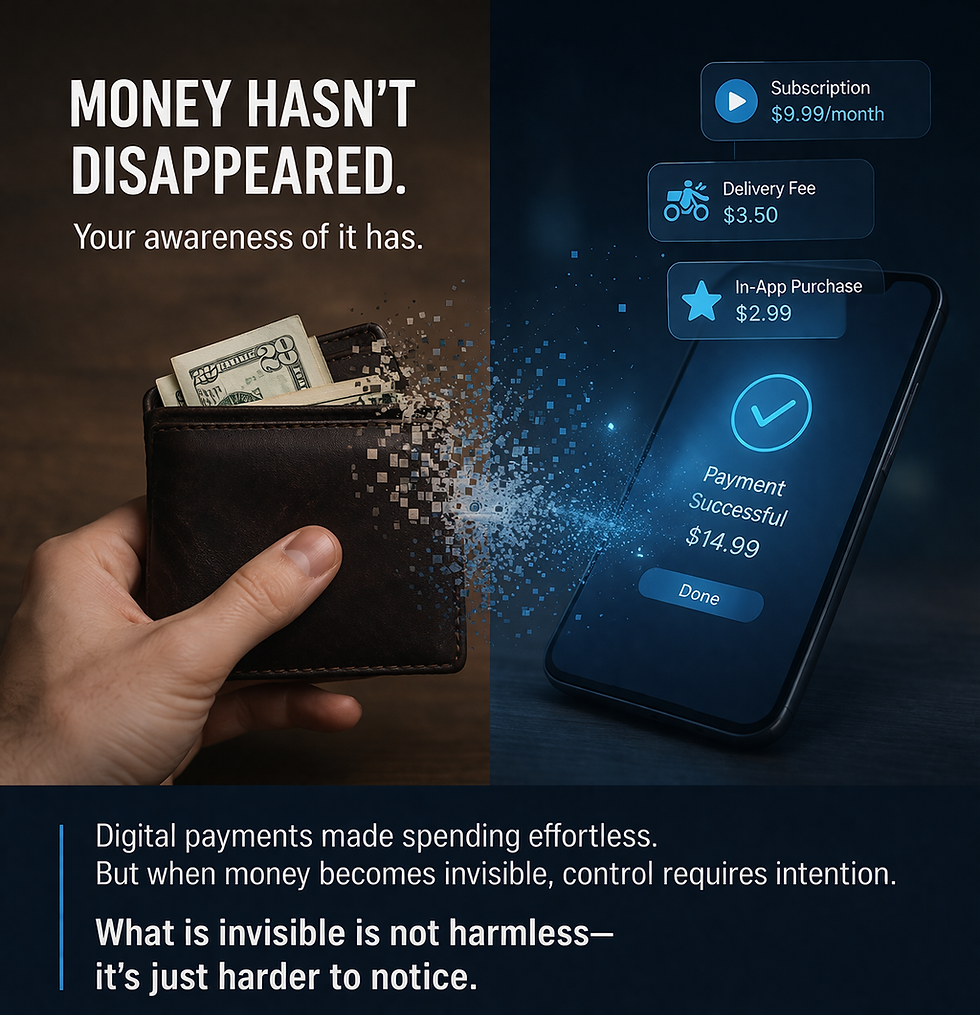
Money Still Loses Value—But We Notice It Less
Money has always lost value over time. Inflation ensures that.
That’s not new.
What is new is how easily spending now slips past our attention. When money becomes less tangible, it also becomes less present in our thinking.
Prices feel less immediate. Transactions feel lighter. The connection between what we spend and what we have left becomes less obvious.
So while money continues to lose value in the traditional sense, we’re also becoming less aware of how we use it day to day.
Control Has Become Less Visible
It would be easy to say that digital systems take control away from people. That’s not entirely accurate.
The tools to manage money are still there—arguably better than ever. We can track spending instantly, set limits, automate savings.
But those tools require attention.
And attention is exactly what frictionless systems reduce.
So control hasn’t disappeared. It has just become less automatic. Less visible.
Something that has to be exercised deliberately.
A Subtle but Meaningful Shift
None of this is an argument against digital payments. The benefits are clear, and they’re here to stay.
But it is worth recognizing the trade-off.
When money becomes invisible, awareness doesn’t disappear—but it does weaken. And without awareness, small decisions become easy to ignore.
Until they aren’t.
Closing Thought
Money has always been subject to erosion over time.
What has changed is how quietly it now leaves our hands.
And in that quiet, control isn’t taken from us—it’s something we gradually stop exercising.
Often without realizing it.
A Practical Perspective
Whether at a personal level or within complex projects, the principle remains the same:
Small decisions, repeated over time, shape financial outcomes.
In operational and project environments, this rarely appears as a single critical issue.
Instead, it emerges through incremental costs, unnoticed inefficiencies, and assumptions that are not regularly revisited.
Without clear visibility, it becomes difficult to distinguish between necessary expenditure and avoidable loss.
Maintaining that visibility requires more than tools—it requires structured review, technical understanding, and consistent oversight across financial and operational components.
Final Note
Digital systems have made transactions faster and more efficient.
But efficiency without visibility introduces risk.
In both personal finance and project execution, control depends on the ability to monitor, assess, and respond to what is happening beneath the surface.
This is particularly relevant in environments where financial decisions are closely linked to technical and operational factors.
Ensuring that these elements remain aligned—and that deviations are identified early—often requires an independent and disciplined approach.
Where financial performance is influenced by technical execution, independent oversight and structured advisory can provide the clarity needed to support informed decision-making.
Comments